
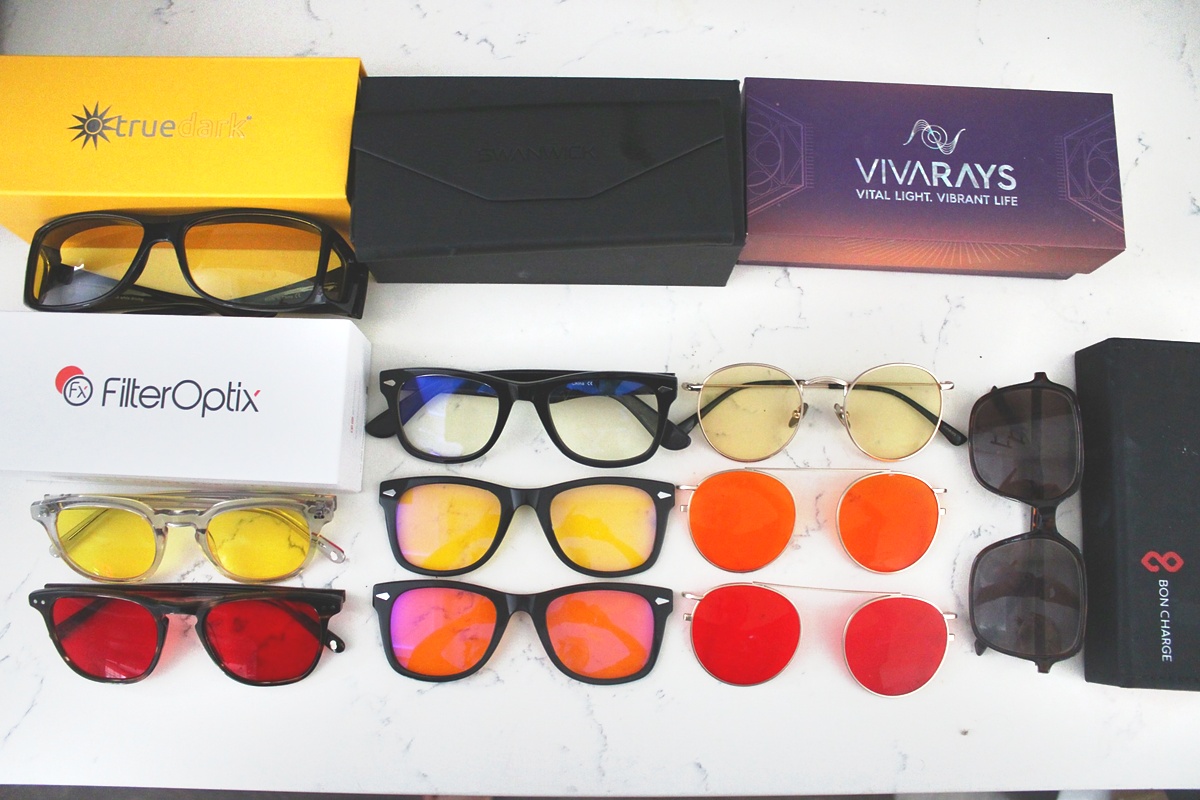
If you’re looking for the best blue light blocking glasses, I’ve tested the proven favorites. I’m sharing what’s actually proven, what’s not, how to find the right pair for YOU and my top favorites!

Does Blue Light Actually Damage Your Eyes?
Short answer: there’s no solid evidence that it does. The American Academy of Ophthalmology has stated directly that it “does not recommend blue light-blocking glasses because of the lack of scientific evidence that blue light is damaging to the eyes.” The studies suggesting blue light harms retinal cells come from cell cultures and animal models exposed to doses far higher than anything you’d get from a phone or laptop screen. For context, the sun puts out dramatically more blue light than your devices ever will, and nobody’s recommending you avoid windows.
Do Blue Light Blockers Improve Sleep?
A Columbia University study of 14 people with insomnia found that wearing amber-tinted lenses for two hours before bed resulted in about 30 extra minutes of sleep compared to clear lenses, along with improved sleep quality. A separate presentation from Nova Southeastern University found blue-light-filtering lenses worn after 6pm nearly doubled melatonin levels in participants.

The Sleep & Melatonin Evidence
Sleep
+30 min
Extra sleep per night wearing amber, blue-light-blocking lenses 2 hours before bed instead of clear lenses, per a Columbia University sleep study of 14 people with insomnia
Melatonin
~2x
Melatonin levels, the hormone that regulates sleep, in people who wore blue-light-filtering lenses after 6pm, per a Nova Southeastern University study
On the more skeptical side, other researchers point out that melatonin suppression from a single evening of blue light exposure tends to recover within about 15 minutes once the light source is removed, meaning the practical impact for most people may be smaller than it sounds. My honest take: the amber-lens-before-bed approach has more research behind it than the “block eye strain all day” claim does, but it’s still not a guarantee, and it works best alongside other sleep habits, not as a replacement for them.

Clear vs. Amber / Tinted Lenses: When to Use Which
Clear (“computer glasses”)
Filters a smaller percentage of blue light, usually 400-455nm, without changing how your screen looks. Meant for daytime use, but blocks the least, so it’s doing the least for the sleep-related use case.
Amber / tinted
Blocks a much higher percentage, often 90-100% of 400-550nm, closer to what the sleep research above actually tested. Meant for evening use only, since wearing an amber tint all day distorts color perception.
If you’re buying blue light glasses purely to try to help with nighttime scrolling and sleep, the amber/tinted version is the one backed by actual studies. If you just want daytime glasses and blue light filtering is a bonus feature, clear is fine, just don’t expect much from it.

How to Tell If Your Glasses Actually Blocks Blue Light
Cheap blue light glasses frequently don’t block meaningfully more blue light than a clear pane of glass. Here’s a few ways to check:
Before you buy (or after)
- Look for a stated percentage and wavelength range. “Blocks blue light” with no number is a red flag.
- Check for lab or third-party testing claims, not just internal marketing copy.
- Do the RGB test at home: pull up pure blue (RGB 0, 0, 255) on your screen and look through the lenses. A real blue-blocking lens will visibly shift it toward green or gray.

I Tried FilterOptix Yama and Acero Glasses
I tried FilterOptix blue light blocking glasses: the Yama in Cinnamon, a classic square frame that runs slightly oversized, and the Acero in Mist, which mixes soft curves with more defined lines and has a more compact fit. Both are handcrafted from bio-based, biodegradable acetate with a stainless steel core, so they feel lightweight without feeling flimsy and I can immediately tell how high quality they are compared to the plasticy feel of Truedark. Every lens has a clear wavelength cutoff and a time of day it’s meant for and are available in non-prescription, prescription, and reader options. These are the most advanced lens I’ve experienced:
- Made from optical-grade CR-39, selected for its optical clarity and durability.
- Anti-reflective properties to reduce glare and reflections
- Hydrophobic properties to help repel water and moisture
- Oleophobic properties to resist grease and fingerprints
- Anti-static properties to reduce dust accumulation
- Scratch-resistant protection for improved durability
FilterOptix’s clear lens filters about 35% of blue light across 400–495 nm and blocks 100% of UV and HEV light up to 410 nm, their yellow lens blocks 100% of light up to 470 nm and filters about 90% of blue light while providing visual contrast, their orange lens blocks 100% of light up to 520 nm, plus all blue light and part of the green-light spectrum and their red lens blocks 100% of light up to 550 nm, plus ALL blue light and a greater portion of the green-light spectrum than the orange lenses. I feel like the yellow truly helps me with eye strain from staring at the screen morning to night and the red helps prepare my body for sleep. The red is difficult to see through so I would only wear them while doing a very relaxing activity or nothing at all.
FilterOptix Yama and Acero Specs
use OBL for 15% off

I Tried TrueDark Daylights Fitovers
TrueDark fitovers are super convenient if you don’t want to get a whole new pair of glasses and would rather wear something over your existing pair for small periods of time. Truedark was started by Dave Asprey and built on the idea that eyewear should work like noise-canceling headphones for your eyes, filtering out the “junk light” from screens, LEDs and overhead lighting. I tried the Daylights Fitovers which fit right over regular glasses or readers, so I don’t need a separate pricey prescription version to wear them. The wraparound frame has side shields, which is excellent for true blue light blocking since it cuts down on light coming in from the edges. The yellow tint is made for the hours you spend under office lighting and in front of screens, from mid-morning through early evening. TrueDark suggests getting about 30 minutes of morning sunlight first, then putting them on. They look like safety glasses and even though they’re on the big side, I do find them to be lightweight. My main complaint is the arms start hurting behind my ears, so I wish they would make them more comfortable. I would say I can only wear them for around two hours before they start to dig in.


TrueDark Daylights Fitovers Specs

I Tried Bon Charge Blaire Sunglasses
Bon Charge is one of the only few companies making blue light sunglasses with prescription that block harmful blue light. I picked the Blaire because I wanted one pair that could do double duty, sun protection plus blue light filtering. Bon Charge designs its lenses to let beneficial red light through rather than blocking everything, which is the “circadian-friendly” angle the brand builds its glasses around, and the blue light filtering is backed by its own spectrometer testing. I love that Blaire has an oversized large frame to protect more of the skin around my eyes. On me, the acetate felt smooth and lightweight rather than plasticky, and it’s held up well without loosening at the hinges. The tint is substantial but I don’t find it difficult to see through at all.

Bon Charge Blaire Sunglasses Specs

I Tried Vivarays Aviator Clip’N’Go 3-in-1 Glasses
Vivarays does something different: instead of buying separate glasses for day and night, you get one aviator frame with a yellow daytime lens plus two magnetic clip-ons you swap in as the day goes on. The yellow DayGo’z lens is for indoor lighting and screens during the day, the orange Eve’z clip-on goes on after sunset to help you unwind, and the red Sleeper’z clip-on is for the hour or two before bed. I find the magnets are strong enough that they don’t slide around or fall off during normal wear. I like that one frame covers my whole day, and the Aviator is a very light pair of glasses so adding clip-ons doesn’t feel too heavy on my face. The red clip-on is the one that makes the biggest visible difference that’s meant for before bed, while I wear the yellow during the day and orange in the evening.

Vivarays Aviator Clip’N’Go 3-in-1 Specs
use OBL for 10% off

I Tried Swanwick Swannies
Swanwick Swannies is a 3-in-1 blue light glasses system with a base frame and three clip ons. They’re split by time of day: Focus Swannies with a yellow lens for screens and indoor light, and Sleep Swannies with an orange lens for the evening. Rather than a blanket percentage claim, Swanwick targets the harshest part of the blue light spectrum while letting through the range tied to alertness during the day. Their Sleep Swannies are surprisingly a deep orange versus the red that other glasses before sleep usually have. The yellow daytime lens is light enough that colors on my screen still look accurate, and the spring hinges make them comfortable for all-day wear. There are lots of frame styles and sizes, so it’s easier to find a proper fit. The Swannies are a thicker frame so I can feel the weight difference when I tack on a clip-on.

Swanwick Swannies Specs
use OBL for 10% off

FAQ
Do blue light glasses really work?
For eye strain, the evidence doesn’t support it, the AAO and Cochrane Collaboration both found little to no proven benefit. For sleep, there’s modest, genuine evidence behind amber lenses worn in the evening, though it’s not a guarantee and works best paired with good sleep habits.
Can blue light damage my eyes long-term, like cause macular degeneration?
There’s no human research showing this. The studies raising concern used cell and animal models exposed to blue light doses far beyond normal screen exposure.
What’s the difference between blue light glasses and computer glasses?
“Computer glasses” usually refers to clear lenses with a lighter blue light filter, sometimes combined with mild magnification for screen-distance focus. “Blue light glasses” more often refers to the amber/tinted versions with heavier filtering, typically marketed for evening use.
Should I wear blue light glasses all day?
Clear daytime versions are fine to wear all day since they don’t change how things look. Amber/tinted versions are meant for evening use specifically, wearing them all day will distort color perception and isn’t necessary since the sleep-related benefit is about evening light exposure.
Are expensive blue light glasses actually better than cheap ones?
Not automatically, but cheap, generic pairs are more likely to make vague claims without a stated blocking percentage or independent testing. A brand being specific and transparent about their lens data is a good sign regardless of price point.
Bottom Line
Don’t buy blue light glasses expecting them to fix eye strain, that’s not what the evidence supports, and the 20-20-20 rule plus better screen habits will do more for you. But if you want real UV protection with blue light filtering built in for daytime, or you want to try filtering blue light before bed with real research behind it, Bon Charge’s Blaire sunglasses and Vivarays are both solid, transparent options if you want to try it.
Sources
- American Academy of Ophthalmology — Are Blue Light-Blocking Glasses Worth It?
- McGill Office for Science and Society — Feeling Blue about the Evidence for Blue-Blocking Glasses
- American Optometric Association — Amber-tinted Lenses and Blue Light
- Columbia University Irving Medical Center — Amber-tinted Glasses May Provide Relief for Insomnia
- Flex — Are Blue Light Blocking Glasses HSA/FSA Eligible?
- Cleveland Clinic — Do Blue Light Glasses Work?

Related posts:
Best Non Toxic Weighted Blankets I've Tried

Building a Sustainable Handbag Brand with Carry Courage Founder Marisa Hilarides

I Tried the Best Coffee for Cold Brew (Mold Free!)
My Brutally Honest CrowdHealth Review After One Year
Best Non Toxic Curtains I've Tried (Blackout Options)
The Best Non Toxic Pajamas I Actually Wear (Organic Cotton options)
Andrea is a clean beauty expert born in Los Angeles, California with 10 years of experience in natural skincare and organic living. She writes for Organic Beauty Lover using her expertise to guide readers in choosing the best natural products. Andrea graduated from the University of Southern California’s Marshall School of Business and has worked at NBC Universal, Four Seasons Hotels and Resorts, and The Travel Corporation while freelancing for small businesses. As a multi-citizen, she considers herself a global citizen of the world, belonging nowhere and everywhere, and has lived across Europe, US, Asia and South America. She currently resides in Orange County since 2026 and loves yoga, coffee and exploring the desert. Connect with her @organicbeautylover.
JOIN OUR NEWSLETTER! No spam ever.








Leave a Reply