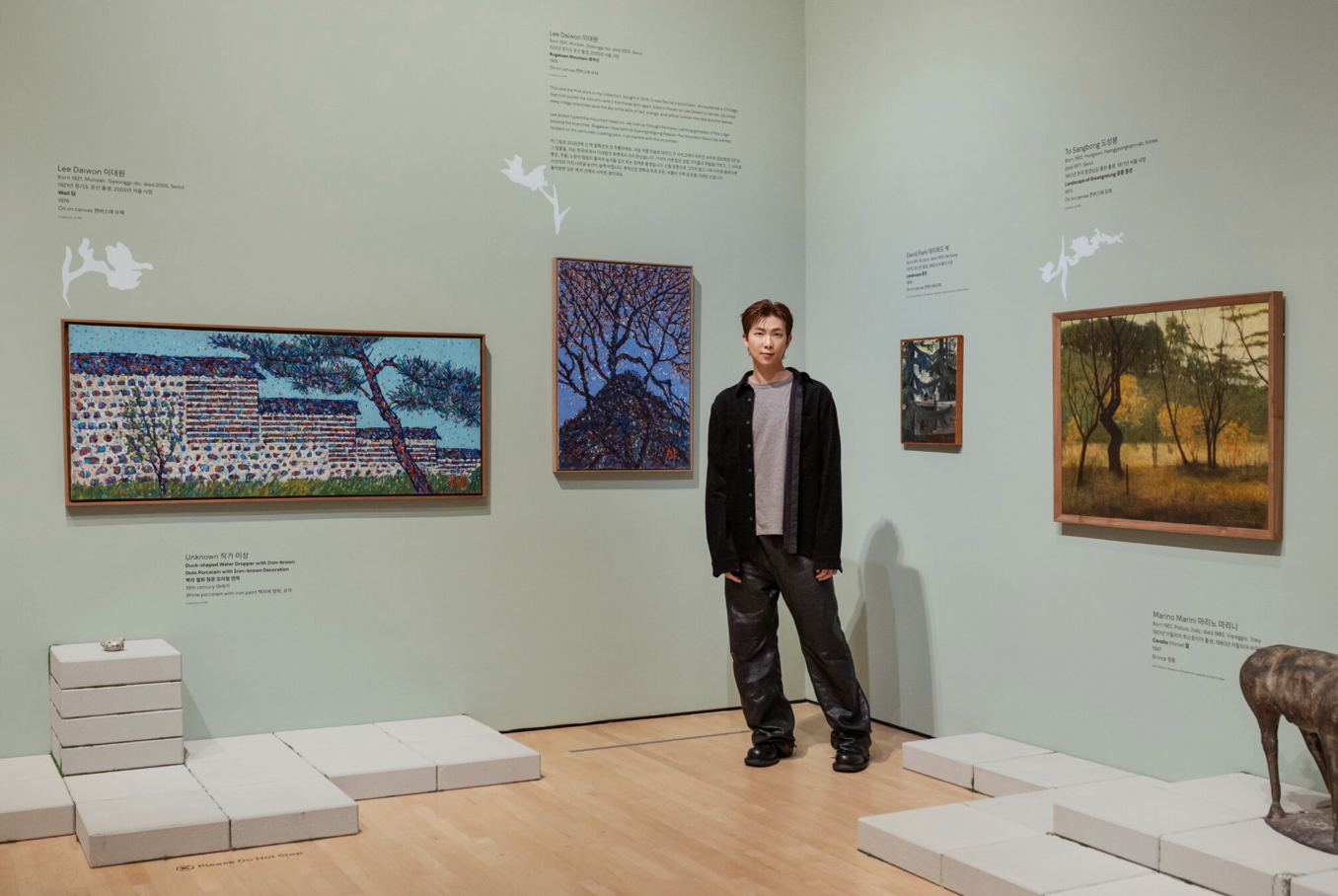
I visited RM x SFMOMA Between You and Me and I’m sharing my experience.

“Welcome to my world. I appreciate you spending time with my confusion.” That’s how RM, BTS’s leader, who asks visitors to simply call him Namjoon, opens his audio guide to RM x SFMOMA: Between You and Me. It sets the tone for one of the most personal museum exhibits I’ve ever visited. (Disclaimer: I’m not an art expert, not ARMY nor am I all that familiar with Kpop or RM. I just happened to be in SF and enjoy art haha!)

The San Francisco Museum of Modern Art’s exhibition is the first ever museum show of RM’s private art collection. It pairs 142 works from his collection, mostly by Korean artists like Park Rehyun, To Sangbong and Chang Ucchin, with 36 pieces from SFMOMA’s own collection by Mark Rothko, Kim Whanki, Milton Avery and more.


There is SO much to see in this exhibit, you could spend all day on his floor alone. There’s painting, calligraphy and sculpture, and even a Pokémon animation cel. RM co-curated the show and recorded an audio guide in English and Korean. He made the in-gallery playlist too, and wrote every label himself, mixing art history with personal, almost diary-like reflections. One room is even titled “I Don’t Know, But I Like It.”
As a Korean-American, this is the first time in my life I’ve seen an art exhibition in the US that’s written in both Korean and English and the fact that I could actually read the writing was very cool. Seeing the Olive Young store in Los Angeles was also pretty mind-blowing!


RM’s favorite is the buddha watching TV. It’s set up like a Photo Booth and a Buddha statue is captured by a closed-circuit camera, staring at a live video feed of its own face on a television monitor.
I think RM was getting at how he’s constantly being watched, and how strange it is to always be seen as “RM.” So there’s something poignant about this Buddha endlessly staring at its own image on the screen. It’s both observer and observed, caught in a loop of being looked at. It’s a very human experience to spend most of our lives worrying about how we’re perceived.

Chung Sang Hwa, Untitled (1975)
Chung Sang Hwa was a leading artist of Dansaekhwa, the Korean monochrome painting movement. This all-white canvas looks simple from afar, but up close it’s covered in tiny, cracked tiles of paint. He made it by layering paint, folding the canvas so it cracked, then removing and refilling the gaps by hand, a slow and repetitive process. The result feels meditative, like a textured surface of time and labor.
The nature gallery
This room of RM’s show is devoted to landscape and nature. A large snowy stream scene with ducks hangs alongside smaller paintings of mountains and forests, and painted silhouettes of trees run across the wall. The mix of Korean and American works invites you to compare how artists from different places see the natural world.

I personally like the rock with the word candy engraved on it in orange by the contemporary multimedia artist Wonwoo Lee. Love the juxtaposition of something sweet and artificial against a tasteless natural object.

It’s very interesting to hear his thoughts on his art, and that personal aspect of this exhibition immerses you in a way most exhibitions don’t. “I make an album because all of my feelings can’t be just translated by words,” he says, and this exhibition comes from the same place. It’s quiet, reflective and deeply heartfelt, and it’s clearly resonating.

To Sangbong, Landscape of Gwangneung (1973)
To Sangbong was known for his gentle, realistic paintings, especially still lifes of white porcelain and lilacs. Here he paints the forest of Gwangneung, a wooded area near Seoul home to royal tombs. Bare, twisting trees stand against soft golden foliage and a misty line of pines, all in muted, earthy tones. The painting has a calm, almost dreamlike quality.

Milton Avery, Clear Cut Landscape (1951)
The American painter Milton Avery was known for flattening nature into simple shapes and soft blocks of color, an approach that influenced artists like Mark Rothko. In this landscape, deep blue mountains, a green grove and a gray-green evergreen sit against a pale peach sky and a lavender field. Two white, rope-like forms add texture on the left. The title refers to logged land, which gives this peaceful scene a quieter layer of meaning.
No surprise here, but more than 66,000 tickets were sold, with advance sales six times higher than any previous show at the museum. I’ve heard the reddit chatter of how it’s a cash grab, pretentious etc which is looking at it through a very negative lens. I think the fact that RM is able to bring Korean art to the rest of the world, this tiny country whose artists the world cares little for, is amazing.

Kim Whanki, Plum Blossom, Moon and White Porcelain (1950s)
Kim Whanki is often called the father of Korean abstract art, and this painting brings together three of his favorite symbols. A dark plum blossom branch, a full blue moon and a white porcelain moon jar all sit against a textured field of blue. These are classic motifs of Korean tradition, simplified into bold, almost abstract shapes. The thick, sandy texture of the oil paint gives the piece a quiet, timeless feel.
As he puts it, if you leave with “something memorable,” that’s the only duty an exhibition has. I don’t believe art has to be pretentious even though it certainly feels like it’s reserved for certain circles of society. Art is dying, museums are struggling, and I think RM is doing something you don’t see a person of his status and fame doing often.

My favorite has to be Kim Tschang-Yeul Waterdrops – this one took my breath away. I never knew something so simple as a water drop, an occurrence in my daily life that I never give a second thought to, could be so moving. Now that I have experienced a certain amount of trauma and pain in my life, I find myself seeking healing through ways I didn’t before, whether it be through art, yoga or travel. I could never afford this artwork in my own home, but I at least have this picture and memory to keep.
My water drop paintings are accomplished under the encounters of my life experiences and my plasticizing experiences. Each clear, impeccable water drop is in its initial state since purification, as if it is a recurrence of absolute nothingness; the water drop is also what it finally returns to.
Kim Tschang-yeul
Kim Tschang-yeul, Waterdrops (1978)
Kim Tschang-yeul spent his career painting a single subject: water drops. They’re so realistic they look like you could wipe them off the rough hemp canvas. The series began by accident in the early 1970s, when he sprayed water on a canvas in his studio outside Paris and found the drops catching the morning light. RM’s label notes that the drops here look like a map of Korea, with the lone drop at the bottom as Jeju Island. Kim called Jeju his second home and donated about 200 works there.

I also really loved Park Rehyun’s artwork. She’s one of the few women painters in the exhibit, and her work stood out to me for its quiet strength.
Park Rehyun
Park Rehyun was one of Korea’s most important women painters, and this large abstract work shows her mature style. Textured layers of ink and color in blues, browns and grays build up loose, organic shapes that seem to float against the white paper. The wall quote beside it captures the tension she lived with as an artist, a wife and a mother: “When am I ever to paint, which is my real work?” It’s a reminder of how much she created despite the demands of domestic life.
I was a bit disappointed by the merch. I was hoping there would be more prints I could take home of all the Korean artwork but there was only a few prints made.

Related posts:



Andrea is a clean beauty expert born in Los Angeles, California with 10 years of experience in natural skincare and organic living. She writes for Organic Beauty Lover using her expertise to guide readers in choosing the best natural products. Andrea graduated from the University of Southern California’s Marshall School of Business and has worked at NBC Universal, Four Seasons Hotels and Resorts, and The Travel Corporation while freelancing for small businesses. As a multi-citizen, she considers herself a global citizen of the world, belonging nowhere and everywhere, and has lived across Europe, US, Asia and South America. She currently resides in Orange County since 2026 and loves yoga, coffee and exploring the desert. Connect with her @organicbeautylover.
JOIN OUR NEWSLETTER! No spam ever.








Leave a Reply