
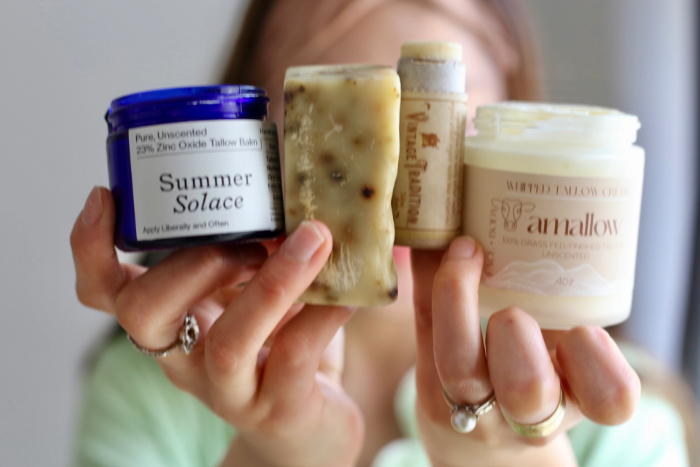
I tried a tallow skincare routine for an entire month using products I purchased myself, and I’m sharing my experience. I’ve found that the best quality tallow will be organic and dry-rendered and made without any questionable ingredients, parabens, petroleum-based fillers, synthetic fragrance, or fragrance.
Is beef tallow better than plant-based?
Tallow has been historically used for millennia and is readily absorbable, suuuper abundant in fat-soluble vitamins and minerals and safe for all skin types. It can help with skin barrier protection, moisture retention and anti-inflammation. This study concluded that it can increase fatty acid concentration in the skin and even help with skin conditions such as dermatitis, psoriasis, dry skin, and wounds.(1)
Here’s some of tallow’s awesome properties:
- Packed with fatty acids including oleic, palmitic, stearic, alpha-linoleic, and conjugated linoleic (CLA)
- Composed of 50% saturated fat, 42% monounsaturated fat, and 4% polyunsaturated fat
- High in vitamin A, vitamin D, vitamin E, and K
- Its composition closely mimics human skin oils (sebum)
- Low comedogenic profile (doesn’t clog pores but acne-prone skin should proceed with caution!)
Who shouldn’t use tallow
Those with active breakouts, acne prone skin and easily clogged pores should avoid using tallow. Tallow is extremely heavy and can exacerbate certain skin issues.(2)
What is Tallow and How to Find the Best
If you’re not familiar with tallow, it’s the rendered fat from the suet of cattle that’s raised for meat. Specifically, it comes from the fat surrounding the loins and kidneys, which is why sourcing matters.
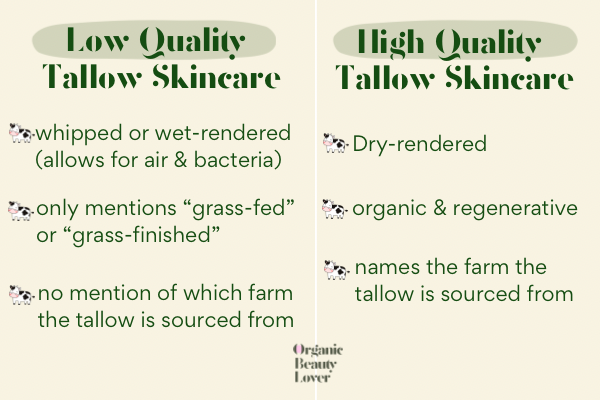
Here are my tips to finding the ABSOLUTE best tallow out there. Most brands can’t trace where their tallow comes from or if they’re using fresh tallow at all.
- First, avoid brands that ONLY mention “grass fed”. Knowing how horrible the meat industry is in the US, I couldn’t use the bodies of precious animals who have lived in horrific conditions, never having seen the sun or roamed free. If a brand can’t say anything else beyond “grass-fed” and “natural” I would be skeptical. This is a dead giveaway that the company doesn’t know anything else about their own tallow and most likely uses a manufacturer that mass-produces products for dozens of brands.
- Be sure to look for more information or certifications beyond just “grass-fed.” Do they know which farm it comes from? Can they tell you how the cattle is raised?
- Avoid whipped and wet-rendered tallow. Whipped tallow may be more pleasant to use, but it’s a sign of low quality AND you get way less product. It’s also a cheap and amateur way of making tallow, since you’re basically paying for air! These methods can also introduce bacteria and mold into products. Choose dry-rendered instead. The consistency is going to be way denser but it’s going to be packed with way more nutrients.
My Personal Thoughts after 30 Days
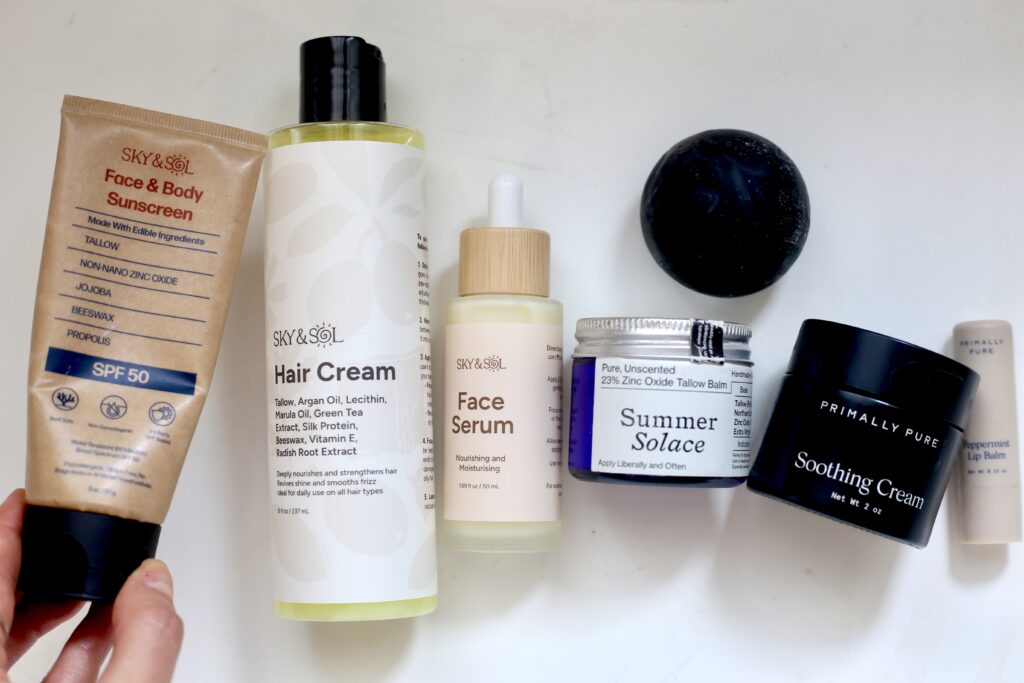
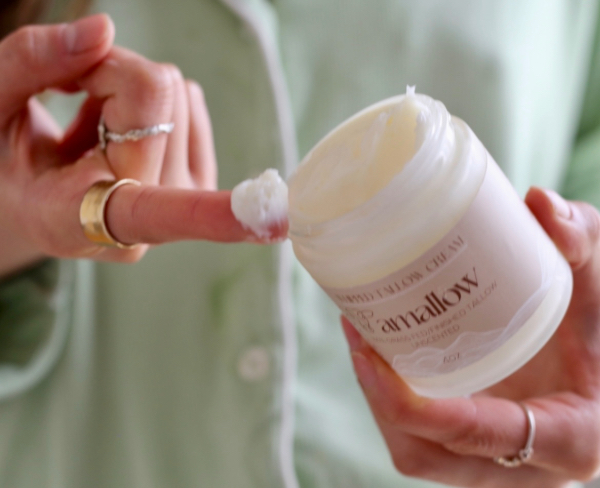
I tried the most popular brands like Amallow, Vintage Tradition, Sky and Sol, Summer Solace and Primally Pure. I started with using a tallow soap bar to remove makeup and clean my pores. I noticed right away how creamy and moisturizing it felt compared to normal bar soap! Then I used a tallow moisturizer and sunscreen during the day followed by a tallow face oil and balm at night.
Most of the popular tallow face creams I used had a greasy texture I just couldn’t get over. The brand that impressed me the most was Summer Solace Tallow. They’re the only one I found that actually makes their own tallow using verified regenerative suet from Stemple Creek Ranch located just 30 miles away from them, then dry-render it using slow, traditional methods. The skincare ingredients they add to it are always organic, local, and high quality.
I also LOVED Primally Pure’s Antioxidant Balm and am still using it to this day. It’s got organic tallow from grass-fed cows along with Organic Jojoba Oil, Organic Plum Kernel Oil, Organic Green Coffee Oil, Unrefined Beeswax, Cacay Nut Oil, Hibiscus Oil. It’s so so nourishing and moisturizing, and helps seal in all the previous skincare products.
I found that tallow soaps are the creamiest soaps I’ve ever used. I’m surprised by how much I enjoyed grass-fed tallow sunscreen! I tried Sky & Sol’s Face Sunscreen, which feels very much like a light, hydrating lotion and Summer Solace’s which is a dense, rich zinc oxide balm.
Cons to using tallow skincare
The cons for me are tallow feels heavier on my skin, some smelled plain old funky and I have to grapple with the fact that I’m using dead cow parts for vanity reasons. One thing I disliked immediately was the greasiness and slightly off-putting scent that made me wanna gag a little. On the bright side, I found the weird scent isn’t noticeable anymore after a minute. But not all products have the typical “tallow odor” since some use essential oils or floral extracts. So if you have a sensitive nose, I would definitely recommend going for one that has those extra ingredients to make it smell better.
I’ve also noticed a lot of people say a certain brand’s face cream isn’t greasy or heavy, but if it has a certain amount of tallow (which you’d want it to), I found there’s no getting around the fact that it’s going to feel greasier than a typical water-based moisturizer. I used whipped face creams and still found the finish to be quite oily!
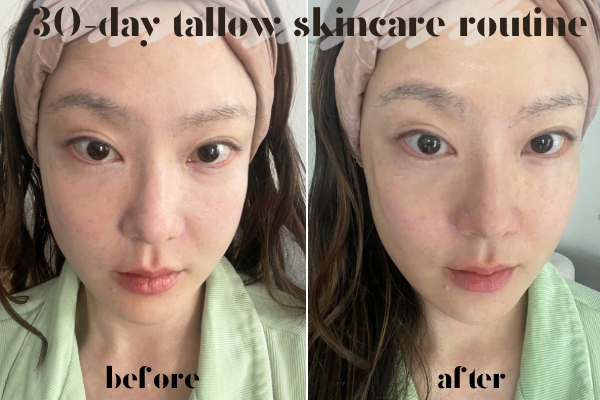
Honestly, after using straightup controversial cow fat on my face I felt like my skin became softer, more moisturized and supple. Would I say it completely transformed my skin? No, I saw some improvements, but nothing that any good and consistent clean skincare routine that matches your skin type wouldn’t bring you. I do personally think that mature skin, deep set wrinkles and troubled skin, like a broken skin barrier or inflamed skin, would benefit the most.
My Verdict
So is beef fat for skin worth the hype? The answer, in my opinion, is it depends on what brand you buy from. Low quality tallow face creams are a no for me, even if they have a small price tag. They’re just not worth it to me and never will be. I am a thousand percent yes on brands that meet my standard of quality and mindfully and ethically create products with care for the animal and land.
Shop HereReferences
- Russell, M. F., Sandhu, M., Vail, M., Haran, C., Batool, U., & Leo, J. (2024). Tallow, rendered animal fat, and its biocompatibility with skin: A scoping review. Cureus, 16(5), e60981. https://doi.org/10.7759/cureus.60981
- Almatroud L., Choi S., Libson K., and Ashack K., “Beef Tallow‐Based Skincare Claims in Social Media: A Cross‐Sectional Analysis,” Journal of Cosmetic Dermatology 24, no. 12 (2025): e70544, 10.1111/jocd.70544.
Related posts:
I Tried 8 Best Non Toxic Air Fryers (what I liked and didn't)
Best Non Toxic Air Fresheners I've Tried (plug in, diffusers, spray)
I tried the Best Non Toxic Bras
Best Non Toxic Mattresses I've Actually Slept In
I Tried the Best Coffee for Cold Brew (Mold Free!)
The Best Non Toxic Yoga Mat I've Tried (2026 Guide)
Andrea is a clean beauty expert from Los Angeles, California with 10 years of experience in natural skincare and organic living. She writes for Organic Beauty Lover using her expertise to guide readers in choosing the best clean products. Andrea graduated from the University of Southern California in 2012 and has worked at multiple skincare companies, big and small. Connect with her @organicbeautylover.
JOIN OUR NEWSLETTER! No spam ever.









Leave a Reply