

Here’s my unfiltered review of laser hair removal – it’s painful asf and takes a lot of sessions. I’ve been testing the TRIA 4x laser hair removal device at home and am sharing my brutally honest thoughts and tips to make it less painful. I’ll continue to update this post with my progress, so bookmark this page and check back!

The struggle is real when it comes shaving and waxing, so I finally decided to commit to laser hair removal. Don’t get the IPL devices – only go for diode laser like Tria’s or professional. I’m sharing what laser actually is versus IPL, what it costs compared to everything else, how the Tria 4X works and my experience using it. Fall is also the perfect time to start because you want to avoid sun exposure when doing laser hair removal.
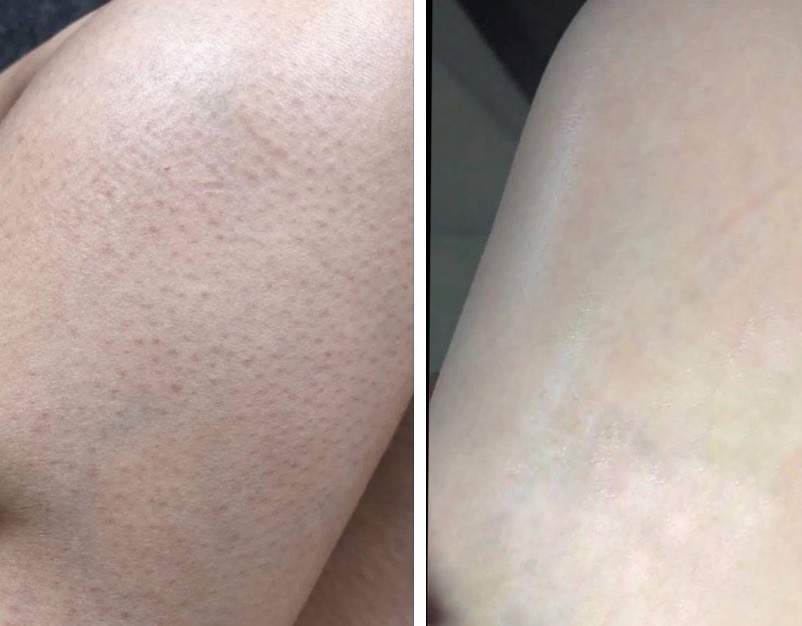
Why I Chose At Home Laser Hair Removal
- Saves money: A Tria device is a one time $600 cost versus thousands of dollars in professional laser sessions (and gas/time) over the same number of treatments.
- No appointments and the comfort of at-home privacy: I do it on my own schedule, in my own home without having to drive in traffic and find parking.
- Actual laser, not IPL: I wanted real diode laser technology rather than the broader, less targeted light most drugstore devices use.
- Less irritation than waxing: No pulling hair from the root every few weeks, no ingrown hairs, no razor burn.
- It fit my skin and hair type: I checked that I was in the right Fitzpatrick range and had dark enough hair before committing, since it doesn’t work for everyone.
- Long-term results: Results are permanent, with maintenance sessions needed.

No More Strawberry Legs and Razor Bumps!
If you’re like me and have strawberry legs (those small pink or dark bumps on your skin), it turns out it was never genetics. It’s actually a hair removal method problem: razor bumps happen when a shaved hair curls back into the skin, and strawberry legs are the follicles themselves (plus trapped debris and oil) showing through as dark dots. The follicle is still fully intact under your skin, so shaving doesn’t touch it, and waxing pulls the hair but leaves the follicle able to grow a new one within days, so you never actually solve the root of the problem quite literally. Laser targets the follicle directly, using a wavelength absorbed by the melanin in the hair to heat and disable it so the hair falls out for good, which means no more strawberry legs!

IPL vs Laser
It’s important to know that IPL and laser are two different methods of hair removal. IPL stands for intense pulsed light — it puts out a broad spectrum of wavelengths all at once, rather than one targeted wavelength. Because it’s scattered across such a wide spectrum, a lot of that light doesn’t do anything useful to the hair follicle at all, and less energy actually reaches the root. Laser, on the other hand, uses a single precise wavelength tuned specifically to be absorbed by melanin in the hair (810nm for Tria). More of the energy goes exactly where it needs to.
IPL tends to top out around 58–74% hair reduction after roughly 12 sessions, and even then it’s temporary because you need regular sessions to maintain it.
Laser can get to up to 100% hair reduction, and with enough consistent treatments, that reduction can become permanent.

Does At-Home Laser Hair Removal Really Work?
Yes, at-home devices do work to reduce hair growth over time, but they’re less powerful than professional clinic machines and require real consistency to see results. Most home systems use IPL (Intense Pulsed Light) rather than a true medical-grade laser, which stuns the follicle to slow regrowth rather than destroying it outright. Some clinics use IPL too so make sure they use diode.
Realistic results you can expect, no BS:
- Hair reduction, not elimination: hair gets noticeably finer and sparser after a few weeks of consistent use. Personally, I noticed significant reduction after just my first session but I know everyone’s results will be different.
- Not permanent on its own: you’re looking at long-term reduction, which means occasional maintenance sessions down the line, not a one-and-done fix.
- Contrast matters: these only work well with high contrast between skin and hair — light skin paired with dark brown or black hair. Blonde, red, gray, or white hair just won’t respond.
Home vs. professional:
- Cost and privacy win for home devices: it’s significantly cheaper, and you can do it on your own couch instead of having to drive somewhere.
- Lower speed and power: treatment windows are smaller so sessions take longer, and the lower energy output means it takes more time to see the same results a dermatologist’s office could give you faster.
For reference, the independent clinical study behind Tria 4X found (21 participants, self-assessment scores) up to 61% hair reduction after just 1 treatment, up to 75% after 2 treatments, and up to 100% hair reduction after 8 treatments.
Laser Hair Removal Cost vs Other Options
- Tria 4X (at-home laser): $599.99, one time (OBL saves 10%). Permanent results, up to 100% hair reduction in 8 treatments.
- In-clinic laser: $2,000–$5,000 for a full 8-session course. This uses essentially the same technology as Tria 4X — a precise wavelength, usually in the 800–810nm range, targeting the follicle at the root — just at higher power and with a much higher price tag, since you’re paying for the equipment and the provider’s time and expertise.
- IPL devices: $150–$1,000 one time, but because IPL only offers temporary results you need ongoing sessions.
- Waxing: an estimated $8,000–$23,000 over a lifetime, for a method that only ever produces short-term, a whole lotta pain and irritation, temporary results and has to be repeated on a strict schedule to keep hair away.
- Shaving: an estimated $3,000–$10,000 over a lifetime and if I could add a cost for “I need to shave” anxiety I would. Also comes with irritation, ingrown hairs, and nicks.
What Is Tria 4X?
Tria’s new and improved 4X laser hair removal device just launched in 2026, and it’s currently the only FDA-cleared laser for permanent hair reduction available for home use. Meanwhile a lot of “laser” devices sold for home use are actually IPL, which is a different technology with a different (temporary) result. Tria runs at a precise 810nm wavelength, which is the specific hair targeting wavelength that gets absorbed by melanin in the hair. It delivers up to 233% more power than leading IPL devices.
How It Actually Works
The mechanism is pretty simple once you break it down into steps:
- The laser beam targets the hair follicle at the root, without damaging the surrounding skin.
- That laser energy is absorbed by the melanin inside the hair, which heats up the follicle.
- The heat disables the follicle, and the hair falls out.
- After multiple treatments, this process can become permanent — the follicle stops producing new hair.
This is also why laser (unlike shaving or waxing) can actually break the cycle instead of just resetting it.
How to Get the Best Hair Removal Results
Here’s what you should know if you want to get the best results:
- Shave, don’t wax or pluck, beforehand: shave 24 hours before each session so the follicle stays intact. Waxing or plucking removes exactly what the laser needs to target!
- Avoid sun and self-tanner for two weeks prior: both interfere with the laser’s ability to accurately target hair pigment, and sun exposure raises burn risk.
- Skip active skincare the day of treatment: retinol body lotion, acids, and oils increase skin sensitivity and can block laser penetration.
- Patch test first: especially important the first time you use it, 24 hours before your full session.
- Stick to the schedule: treat every 2 weeks, consistently, for 6–8 sessions and DO NOT SKIP sessions and don’t over do it either!
- Use the right setting for you: lower settings (1–2) are more comfortable, higher settings (4–5) give stronger results — work up as your skin tolerates it.
- Overlap each pulse slightly: track where you’ve treated so you’re not missing spots or hitting the same one twice.
- Moisturize and avoid sun after each session: reapply SPF 50+ for two weeks post-treatment, and hold off on exfoliating for at least 5 days.
- Don’t stop early: full results (up to 100% reduction) depend on completing the whole course, plus occasional monthly touch-ups afterward for any regrowth.
My 3 Takeaways
- Hair grows back in cycles and not every hair is in the same cycle, so one session you may be effectively targeting certain hairs and not others. That’s why some pulses hurt and others not at all or less (thinner hairs).
- More sessions within the timeframe does not equal more results. Again, because of the hair cycle. You need to catch them specifically in their anagen growth phase. And do not skip sessions either.
- Sessions will be hard to stick to if you don’t do something to alleviate the pain, whether it’s icing, distracting yourself like I do, or numbing cream.

Must Read Before Doing Laser Hair Removal
Laser isn’t right for every situation:
- Skin tones outside the approved range: it’s only safe for Fitzpatrick skin types I–IV, so it’s not an option for medium-to-deep skin tones (types V–VI), since the laser can’t reliably distinguish between melanin in the skin versus the hair follicle at that end of the spectrum. The device has a built-in sensor that won’t even unlock on skin tones marked “Not Safe” on their chart.
- Blonde, white, red, or gray hair: the laser needs melanin in the hair shaft to work, so it simply won’t respond to light hair.
- Anyone under 18: not approved for use on minors, by themselves or by someone else.
- Pregnant or breastfeeding: explicitly listed as a do-not-use condition.
- Eyes, eyebrows, or eyelashes: risk of permanent eye injury — never go near this area.
- Ears, nipples, genitals, or anus: too sensitive, too pigmented, and too hair-dense for safe use.
- Men’s beard area (face, jaw, neck): hair density there is too high for the device to treat safely.
- Skin with tattoos, moles, birthmarks, freckles, or recent sun exposure: the extra pigmentation confuses the laser’s targeting.
- Damaged or compromised skin: open wounds, cold sores, sunburns, or skin still healing (6–8 weeks) after a peel or resurfacing treatment.
- Anyone on Accutane/isotretinoin or other photosensitizing medications.

How I Use My TRIA Laser (the right way)
Firstly, I made sure to protect my skin and not tan the weeks leading up to hair removal, and no self tanner either (use a bronzing oil that can be washed off instead). I shave the area (not wax or pluck!) because the laser needs that follicle still sitting there under the skin to actually target it. I start my session by cleansing the area and patting it completely dry. Then I apply Tria’s Phytogel so I can stomach the sting from the highest setting. I’ve tried both with and without it and I wouldn’t say it makes a real difference but I’ll take anything. I generally ice the area for a few minutes then apply gel and that really helps numb the pain. I haven’t tackled the bikini area yet because I would most definitely need some heavy duty numbing cream.
I have to hold the bottom of the device against my skin so the little sensor can read my skin tone and make sure it’s safe to use there. It doesn’t work otherwise for safety. I used to start on a lower setting, like a 2 or 3 at the start of each session which doesn’t hurt to me, but now I go straight for the 5. I’d rather have each session be as effective as possible than draw out the whole process with more sessions. NGL, laser hair removal can be super painful (the armpit hurts like a mother** on level 5). Pulses are slower, longer and more painful on the higher intensities and very mild up to level 3. It feels like a literal burn but deep inside your tissue, not a little surface rubber band snap. I try to do yoga stretches so the pain of the stretch distracts me or think about how it’s nothing compared to childbirth or going to war.
This takes a solid half hour chunk of my time so I multitask by getting a red light therapy or sheet mask session in too. Once it gets cold I’ll probably do it while in my infrared sauna. Don’t even get me started on the face! I prefer using the highest setting on my armpits and legs since it’s the most effective – no pain no gain right. On my face I can only handle level 2 or 3 at most. This is useful for those random chin hairs too.
One thing I’ve learned on this whole journey is sometimes you’ll feel pain and sometimes you won’t. Generally speaking, the pain means Tria is killing off the follicle. So pain is good, we want pain. It means the device is working and doing its job. If you don’t feel pain it’s likely that the hair isn’t in its active growth phase.
Hair grows in three phases, and laser only works effectively on hair in the anagen (growth) phase.
At any given time, different hairs across your body (and even within the same small area) are in different phases, which is exactly why laser hair removal is not a one and done operation and needs multiple sessions over many months. Silly me, I always assumed it was for some evolutionary reason — like hair was meant to protect us, so it’s built to resist being permanently removed. In reality, it’s because each session only effectively catches the hairs that happen to be in anagen (growth) phase at that moment.
I press the window flat against my skin, wait for the beep and flash, then slide over just slightly so the next pulse overlaps the last one a little. I basically work my way across the area in sections so I’m not missing spots or accidentally doubling up on the same patch. You can even use white eyeliner to draw overlapping circles to help guide you so you don’t miss any spots. I try to do my armpits, legs and arms during each session and I reach around 1,500 pulses, more if I’m also fitting in my lip mustache and lower back. The device doesn’t last the full session and needs a recharge in the middle (bit annoying it doesn’t work while being charged). It can be long and tedious, but thankfully the Tria has a comfortable handle with good grip and isn’t too heavy. I also make a note on my iPhone calendar so I remember when I’m due for the next session every 2 weeks, because I’d totally forget otherwise.

My Results (Progress Diary)
I was honestly surprised at how well my hair responded to at home laser and I’m super excited this has been working because I was always skeptical. 70% hair reduction after just two sessions at home sounded too good to be true. If only I could make my dark spots go away this fast! I can tell the difference each session has made because my hair normally grows back SO fast and in a few weeks I’d be a bushy forest all over. No one else in my family has as much hair as I do.
First session results: Jotting down notes of changes I noticed. I definitely noticed my hair on my legs and pits grew back a little slower though the hair looked exactly the same. It usually grows back so fast in those areas and I’m normally shaving stubble every few days but it took about a week for stubble to start showing again. I would say I saw a solid 30%-40% hair reduction after the first session and hair grew back scattered.
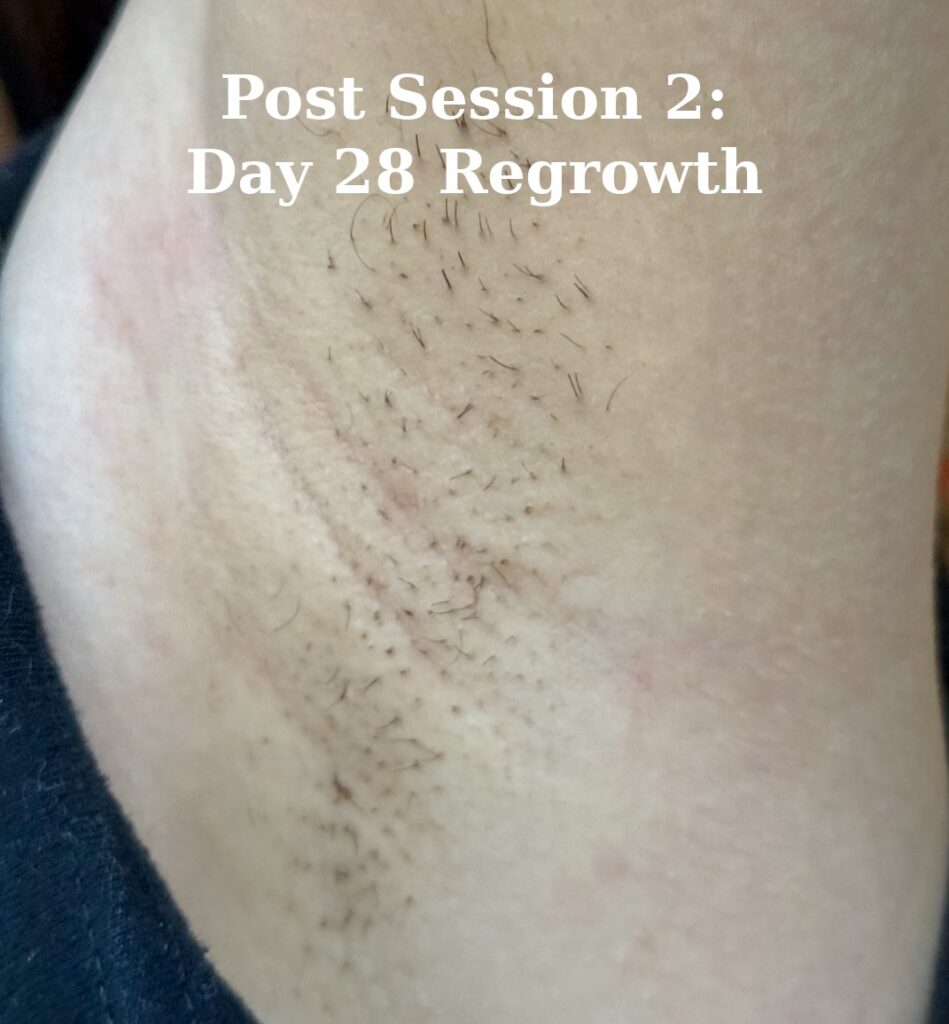
Second session results: My hair regrew pretty slowly again with some patches not even growing back yippee! I saw about 60% hair reduction after the second session and hair grew back scattered and thinner.

Third session results: Can’t tell you how amazing it is that the hair is growing back super slowly or not at all now. I have a lot less anxiety over needing to shave again, which I didn’t realize was such a constant normal part of my life. Girlhood yay. Bookmark this post to check back on my progress diary.
If you want to join me on this laser hair removal journey…
use OBL for 10% off at Tria
Shop Tria →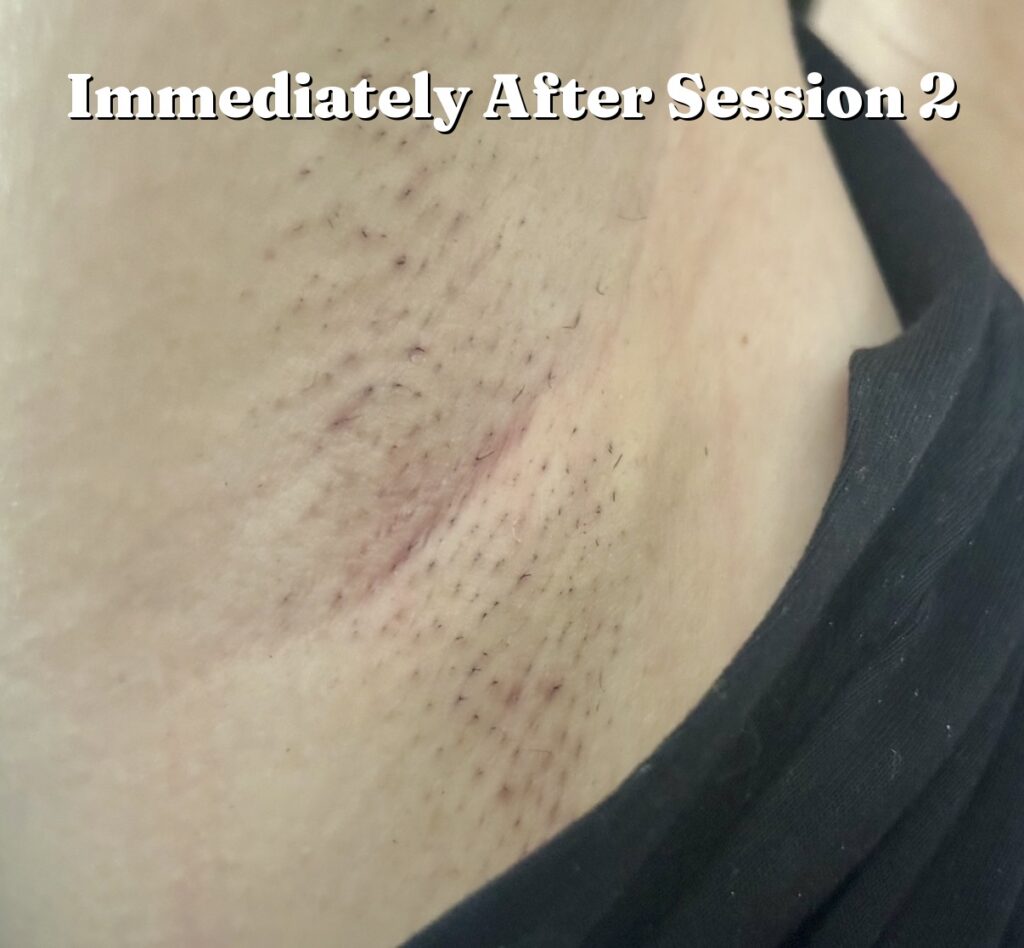
Quick FAQ
Is IPL the same as laser? No. IPL scatters a broad spectrum of light, much of which never effectively reaches the follicle. Laser uses one precise wavelength (810nm for Tria 4X) tuned specifically to be absorbed by melanin in the hair.
Is at-home laser actually cheaper than the alternatives? Yes, over time — it’s a one-time $599.99 versus $2,000–$5,000 for a comparable in-clinic laser course, or thousands more over a lifetime of shaving or waxing that never produces permanent results.
How long until I see a difference? The clinical study shows up to 61% reduction after just 1 treatment and up to 75% after 2 — you don’t have to wait until treatment 8 to notice a change.
Will this help with razor bumps and strawberry legs specifically? Because it targets the follicle instead of just the surface hair, it addresses the actual cause rather than just the symptom, which is different from anything shaving or waxing can do.
Related posts:
Best Non Toxic Face Sunscreen Moisturizer? Only 5 are Worth Buying
I Tried Hyeja Skincare (plus Interview with Founder!)
I tried the Best Non Toxic Lube
I Tried Natural Vitamin C Serums (here's what I liked best!)
I Tried Herbal Face Food for 6 Months (here's what happened)
Best Affordable Non Toxic Skincare (2026 Budget Guide)

Andrea is a clean beauty expert from Los Angeles, California with 10 years of experience in natural skincare and organic living. She writes for Organic Beauty Lover using her expertise to guide readers in choosing the best clean products. Andrea graduated from the University of Southern California in 2012 and has worked at multiple skincare companies, big and small. Connect with her @organicbeautylover.
JOIN OUR NEWSLETTER! No spam ever.








Leave a Reply